

When you think of a Dubai call centre, don't just picture a room full of people answering phones. It's much more than that. Think of it as a strategic nerve centre for your business, staffed by a diverse, multilingual team and powered by some of the world's best technology. This hub is where all your customer conversations—whether by phone, email, chat, or social media—come together to build your brand and drive your business forward.
Why Dubai Is a Hub for Modern Customer Service

Dubai's glittering skyline and reputation as a global business crossroads are well-known. But beneath that surface, the city has quietly become a powerhouse for world-class customer service. It wasn't by accident. Dubai has cultivated a unique environment where modern call centres don't just operate; they thrive.
The secret sauce is the city's incredible diversity. With more than 200 nationalities calling Dubai home, businesses have access to a deep well of multilingual talent. This isn't just a "nice-to-have"—it means you can offer genuine, native-level support to customers around the world, making every conversation feel more personal and effective.
The Evolution From Phone Bank to Experience Hub
The term "call centre" feels a bit dated now, doesn't it? The old image of agents in cubicles fielding one call after another has been completely replaced. Today, we're talking about sophisticated, omnichannel contact centres designed to create a seamless journey for every customer.
This shift is especially clear in Dubai, where ambition and technology meet. A modern Dubai operation is an integrated communications engine that handles everything from the first sales call to intricate post-purchase support. Several key factors have fuelled this change:
- Advanced Infrastructure: Dubai has poured resources into creating top-tier telecommunications and digital networks, which means crystal-clear calls and reliable connections.
- Pro-Business Environment: The government's business-friendly policies and focus on innovation draw in global companies, creating a highly competitive and high-quality service industry.
- Technological Adoption: Companies here are early adopters of new tools, from AI chatbots that handle simple queries to powerful analytics platforms that reveal customer insights.
It's this powerful combination of human skill and smart technology that really makes Dubai's call centres stand out. To see how these elements create better customer interactions, check out our complete guide to elevating customer service in Dubai.
A Strategic Asset for Global Growth
If you only see a Dubai call centre as a way to cut costs, you're missing the true value. It's a powerful strategic asset that can give you a real edge over the competition. By centralising your customer communications in a location known for excellence, you're not just improving efficiency—you're building a stronger brand and earning long-term customer loyalty.
A world-class call centre acts as the voice of your company. In a globalised market, having a multilingual, tech-savvy team based in a strategic hub like Dubai is not just an operational choice—it's a critical component of your international growth strategy.
Ultimately, setting up your call centre in Dubai is an investment in your customers' experience. It gives you the people, the technology, and the supportive environment to meet—and beat—the expectations of a demanding global audience. This is what truly positions the city as a leader in the customer service world.
The Strategic Edge of a Dubai Call Centre
Choosing where to run your customer service isn't just a matter of logistics; it’s a major strategic decision. Setting up a Dubai call centre gives you a powerful mix of financial perks, operational flexibility, and access to an incredible talent pool. When combined, these benefits create a real competitive advantage on the global stage.
Right off the bat, the most obvious win is cost. For companies based in Western markets, the expense of running an in-house contact centre can be staggering. A Dubai call centre presents a much more sustainable financial model, but without cutting corners on quality or expertise.
This cost-effectiveness is what draws many international businesses to the region. Dubai is a hub for specialised talent in finance, healthcare, and tech, with agent rates typically falling between $12 and $25 an hour. Compare that to Western markets, where you might pay $25 to $45 per hour, and the impact on your bottom line becomes crystal clear. You can find more insights on outsourcing advantages in Dubai on callin.io.
Access a Diverse, Multilingual Talent Pool
Beyond the numbers, you'll find one of Dubai's greatest assets: its people. The city is a true global melting pot, home to professionals from over 200 countries. This creates an unmatched reservoir of multilingual talent, ready to support a diverse international customer base.
This isn't just about finding agents who tick language boxes. It’s about delivering culturally aware service. An agent who instinctively understands the communication style and cultural norms of a customer's home country can build rapport faster and solve problems far more effectively.
With a Dubai-based team, you can:
- Offer Native-Level Support: Provide genuine, localised service to customers across Europe, Asia, Africa, and the Middle East.
- Operate Around the Clock: Seamlessly implement a 24/7 "follow-the-sun" support model that covers every time zone.
- Boost Customer Satisfaction: Make customers feel truly heard and understood, which is the cornerstone of great satisfaction scores and long-term loyalty.
Gain Unmatched Operational Agility and Scalability
Business today is anything but predictable. Customer demand can spike overnight during a new product launch or a seasonal rush, only to settle back down just as quickly. A huge benefit of a Dubai call centre is the built-in scalability it offers—think of it as cloud computing for your customer service.
It’s like this: instead of buying and maintaining a massive, expensive server farm (your traditional on-premise centre), you tap into world-class infrastructure and pay only for what you use. You can ramp your agent count up or down almost instantly, without the headache of major upfront investments in recruitment, training, or tech.
This agility means your business can react in real-time. You can absorb unexpected call volumes without a drop in service quality, keeping your customer experience consistently positive. This kind of flexibility is a fundamental part of modern call centre solutions in Dubai and a key driver for efficient growth.
Ultimately, this model doesn't just save you money. It frees up your internal teams to concentrate on what they do best. By placing your customer service in the hands of dedicated experts in Dubai, you gain a partner who is fully invested in your success, backed by top-tier technology and a deep commitment to excellence. The result is a more resilient, efficient, and customer-centric operation.
Choosing Your Call Centre Deployment Model: On-Premise, Cloud, or Hybrid?
Deciding on the right technology foundation for your Dubai call centre is one of the most critical choices you'll make. This isn't just about picking software; it’s about defining your entire operational blueprint. This choice will directly influence everything from your initial budget and long-term costs to your day-to-day flexibility and security.
To make sense of it, let's use an analogy. Think of your call centre's technology like your company's physical home. You have three main options: buy the property outright, rent a fully serviced apartment, or find a custom arrangement somewhere in between. Each path has its own set of responsibilities, benefits, and trade-offs that cater to different business ambitions.
This professional infographic visually represents a modern agent, equipped for 24/7 support, reflecting the high standards of service excellence in Dubai.
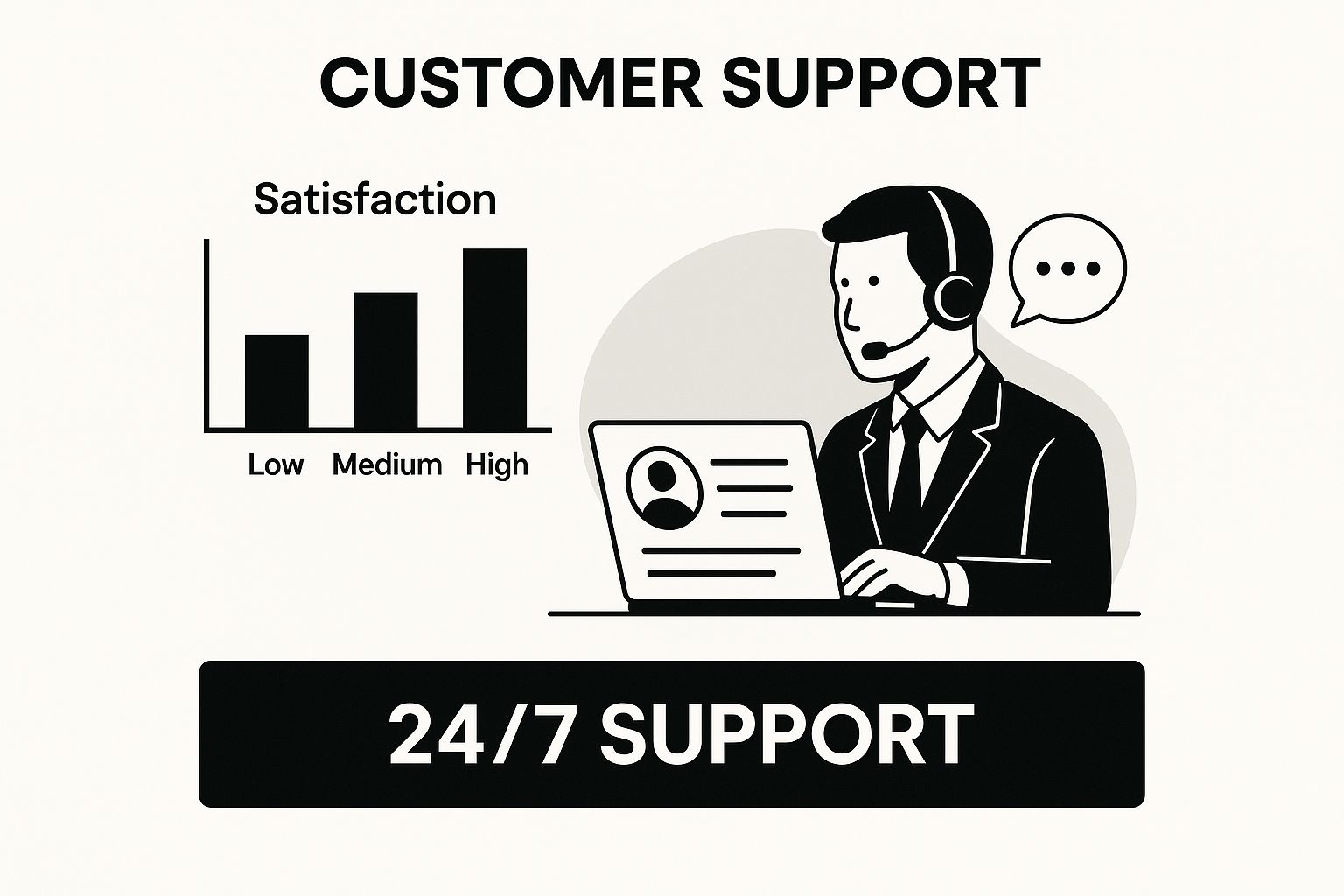
The image highlights the human element at the heart of today's call centre technology, where skilled agents use sophisticated tools to deliver outstanding customer support.
The On-Premise Model: Owning Your Own Home
The on-premise model is the traditional approach, akin to buying a house. You purchase all the necessary hardware and software licences and house them in your own physical data centre. You own the property, the land, and everything inside it.
This gives you absolute control. You manage the security, handle all maintenance, and decide when and how to implement upgrades. For large enterprises in Dubai with strict data sovereignty rules or highly specific customisation needs, this model offers unmatched authority over their systems. However, this control comes at a price: significant upfront capital investment and the ongoing cost of retaining an expert IT team to manage it all.
The Cloud Model: Renting a Serviced Apartment
Cloud-based call centres, often called Contact Centre as a Service (CCaaS), are the modern alternative. In this model, you subscribe to a service from a provider who owns and manages all the technology in the cloud. It’s like renting a fully furnished, serviced apartment.
You pay a predictable monthly fee, and the provider takes care of all the maintenance, security updates, and technical headaches. This model offers incredible scalability—you can add or remove agents with just a few clicks, making it perfect for businesses with fluctuating demand. Better yet, it swaps a large capital outlay for a more manageable operational expense. The trade-off? You’re relying on the provider's infrastructure and have less direct control over the hardware.
The Hybrid Model: The Best of Both Worlds
The hybrid model offers a practical blend of both on-premise and cloud solutions. It combines the solid control of an on-premise setup with the nimbleness of the cloud. Think of it as building a custom home but outsourcing the landscaping, security, and pool maintenance to specialised companies.
For example, a Dubai business might keep sensitive customer data on its own on-premise servers to meet local regulations, but use a cloud provider for its call routing and agent software to gain scalability. This approach allows organisations to strategically balance security, compliance, and flexibility, tailoring the solution to their exact needs without requiring a complete operational overhaul.
To help you weigh your options, here’s a side-by-side comparison of the three models based on key business considerations.
Call Centre Deployment Model Comparison
| Feature | Cloud (CCaaS) | On-Premise | Hybrid |
|---|---|---|---|
| Initial Cost | Low (Subscription-based, minimal CapEx) | High (Requires hardware, software licences, facilities) | Moderate (Combines some CapEx with OpEx) |
| Scalability | High (Easily add/remove users on demand) | Low (Requires physical hardware upgrades) | Moderate (Scales cloud components easily) |
| Control & Customisation | Moderate (Limited to provider's offerings) | High (Full control over hardware and software) | High (Control over on-premise parts, flexible cloud) |
| Maintenance | None (Handled by the provider) | High (Requires dedicated internal IT team) | Shared (Internal team for on-premise, provider for cloud) |
| Deployment Speed | Fast (Days or weeks) | Slow (Months or longer) | Moderate (Depends on integration complexity) |
| Security | Managed by provider (compliance certifications) | Full internal responsibility and control | Shared responsibility model |
| Best For | SMBs, startups, seasonal businesses | Large enterprises, government, regulated industries | Businesses with specific compliance needs |
Ultimately, each model serves a different strategic purpose. Your choice should be a direct reflection of your business priorities.
Choosing the right deployment model is a strategic decision that must align with your company's financial structure, growth plans, and regulatory obligations. There is no single "best" option—only the one that best fits your unique circumstances.
This decision is especially timely in the Middle East. The regional call centre market, with Dubai at its centre, was valued at approximately USD 6.31 billion in 2024. It's projected to grow at a compound annual rate of 12.2% through 2030, a surge driven by software that boosts efficiency—whether deployed on-premise for security or in the cloud for agility. You can explore more data on the Middle East call centre market on cognitivemarketresearch.com.
The Technology Driving Modern Call Centres
Forget the old image of just agents and headsets. A world-class Dubai call centre today is powered by a smart, interconnected web of technology. The goal isn’t just to answer calls faster; it's about building more intelligent, efficient, and genuinely personal customer experiences. When you get the tech stack right, your support centre stops being a cost line and starts becoming a real driver of business growth and customer loyalty.
Think of it less like a box of separate gadgets and more like a central nervous system for your entire customer communication strategy. Every piece works together to capture information, anticipate what a customer needs, and deliver a smooth interaction, no matter how they decide to get in touch.
This shift in technology is what’s behind the explosive growth we're seeing in the region's contact centre market. The UAE's Contact Centre as a Service (CCaaS) market was valued at roughly $1.2 billion in 2025 and is on track to hit a staggering $6.8 billion by 2033. This boom is all about businesses moving to the cloud and using AI to sharpen every single customer touchpoint. You can read more about these emerging call centre trends on backofficeme.com.
The Power of Omnichannel and CRM Integration
Let’s be honest, a customer's journey is never a straight line. It might start with a question on your website’s live chat, turn into a phone call, and finish with a follow-up email. Without the right technology connecting these dots, the experience becomes messy and frustrating, forcing customers to repeat their story over and over.
This is exactly the problem omnichannel routing solves. It pulls all your communication channels—voice, SMS, social media, email, and WhatsApp—into one single, flowing conversation. We dive deeper into building this unified view in our guide to the omnichannel contact centre.
Things get even more interesting when you pair this with a solid CRM (Customer Relationship Management) integration. Your CRM, whether it's Salesforce or Zoho, becomes the single source of truth for all customer information.
- 360-Degree Customer View: The moment a customer calls, the agent’s screen lights up with their entire history—every purchase, past support ticket, and recent interaction is right there.
- Personalised Service: This allows agents to greet customers by name and get straight to the point, making support faster and far more helpful.
- Proactive Engagement: Good data can even trigger proactive outreach. For instance, the system can flag a negative survey response and automatically prompt a follow-up call to resolve the issue.
AI and Advanced Analytics Driving Efficiency
Artificial Intelligence (AI) has moved from science fiction to a practical, everyday tool that boosts both your agents' abilities and your customers' self-service options. AI-powered chatbots are a great example, handling a massive volume of routine questions around the clock. This frees up your human agents to tackle the more complex problems where they can add the most value.
But AI isn’t just about bots. It's also working in the background to make your team smarter and more effective.
An AI-assisted agent can get real-time suggestions during a live call. The system might recommend a specific knowledge base article or suggest the next best step to solve a problem. This doesn't just cut down resolution times; it ensures every customer gets the same high standard of service.
Advanced analytics is the other half of this equation, turning raw call data into insights you can actually use. Sentiment analysis tools can comb through call transcripts to pick up on customer emotions, flagging calls where someone is getting frustrated. Predictive analytics can go a step further, identifying customers who are at risk of leaving based on their behaviour, giving you a chance to step in before it's too late.
Ultimately, modern call centres use this technology not just for day-to-day operations, but for constant improvement. Understanding and applying strategies for effective customer feedback is a critical part of this. It creates a powerful cycle of listening, learning, and adapting that is essential to staying ahead.
Navigating UAE Regulations and Compliance

Running a successful Dubai call centre involves much more than the right tech and a great team. You absolutely have to get your head around the local regulatory framework. For any business that handles customer data, compliance isn't just a box-ticking exercise—it's the very bedrock of customer trust.
Getting this right from day one is critical. It protects your data, your reputation, and most importantly, your customers' privacy. The UAE has built a solid legal structure around data and telecommunications, all designed to create a secure digital economy while protecting individual rights. For a call centre, this translates into specific rules on how you collect, store, and use customer information.
Understanding the UAE Personal Data Protection Law
The centrepiece of data compliance in the UAE is the Federal Decree-Law No. 45 of 2021, which you'll hear referred to as the Personal Data Protection Law (PDPL). If you're familiar with Europe's GDPR, this is the UAE's counterpart. It lays out clear, no-nonsense principles for handling personal data and gives people real control over their information.
This law directly impacts your day-to-day operations. Every recorded call, every customer email, and every note you log in your CRM system is covered by the PDPL. Some of the key things you need to have in place are:
- Explicit Consent: You can't just assume it's okay to collect someone's data. You need their clear and direct permission first.
- Data Minimisation: Don't be a data hoarder. Only collect what you absolutely need for the task at hand.
- Purpose Limitation: If a customer gives you their data to resolve a support ticket, you can't just turn around and add them to your marketing list without asking first.
Following these rules isn't optional. It shows you're a responsible business that respects customer data, which is essential for building loyalty.
Key Regulatory Bodies and Sector-Specific Rules
On top of the PDPL, other authorities have a say in how you operate. The main player in the communications space is the Telecommunications and Digital Government Regulatory Authority (TDRA). They're the ones who set the rules for everything from telemarketing calls to call recording, ensuring everyone plays fair.
And if you're in a specific industry, the rules can get even tighter. For instance:
- Finance: If your call centre supports a bank, you'll be answering to the Central Bank of the UAE. This often means strict rules about where data is stored (data residency) and protocols to prevent money laundering.
- Healthcare: Any operation handling patient data has to comply with health data privacy laws, which demand the highest level of confidentiality.
Staying compliant isn't a "set it and forget it" task. As your Dubai call centre expands, so do your responsibilities. You need to be constantly reviewing your data practices and keeping up with regulatory changes to avoid hefty fines and protect your business.
Navigating these regulations is simply part of doing business here. To get a better handle on the financial side of things in Dubai, this comprehensive guide to UAE accounting and tax services is a great resource. In the end, taking a proactive and detailed approach to compliance is what truly sets a great call centre apart from a merely good one.
Picking the right partner for your Dubai call centre is a big deal. This isn't just about outsourcing calls; it's about entrusting a piece of your brand to someone else. They'll be on the front lines, shaping your customer's experience in thousands of interactions. Get it wrong, and you risk damaging your reputation. Get it right, and you can supercharge your growth and build a fiercely loyal customer base.
Don't let price be your only guide. The best partnership goes deeper than that. You need a team that clicks with your company culture, gets the unique hurdles of your industry, and has the tech and the talent to deliver stellar service day in and day out. This calls for a serious look under the hood, well beyond the glossy sales pitch.
Do They Actually Know Your Business?
Let's be clear: a call centre is not a one-size-fits-all solution. A provider who's a star at handling e-commerce returns might be completely lost when it comes to sensitive financial queries or healthcare support. You need a partner with a proven track record in your specific field.
When a provider already knows your industry, they're not starting from scratch. They understand the lingo, anticipate common customer problems, and are already up to speed on compliance. This means they can get their agents trained and effective much faster, solving issues with a level of authority that inspires customer confidence.
The acid test? Ask for case studies and references from companies in your industry. It's the most reliable way to know if they can truly handle the specific demands and customer expectations of your world.
This built-in expertise is gold. It dramatically shortens the learning curve and ensures the people representing your brand sound like they know what they're talking about from the very first interaction.
Take a Hard Look at Their Tech
A call centre's technology is its engine room. A modern, reliable tech stack isn't just a nice-to-have; it's essential for keeping things efficient, secure, and ready for today's omnichannel customer. You need to dig deeper than a simple feature checklist.
Here are a few critical areas to probe:
- CRM Integration: How well does their system play with yours? Seamless integration with your CRM, whether it's Salesforce or HubSpot, is vital for giving agents a complete picture of every customer.
- Omnichannel Support: Can they manage voice, email, chat, and social media from one unified platform? Customers hate repeating themselves when they switch from a chat to a phone call.
- Security and Compliance: What are their security credentials? In the UAE, for example, top cloud providers like AWS undergo stringent audits from the Dubai Electronic Security Centre (DESC), setting a high bar for data protection.
- Analytics and Reporting: How will you track performance? You need easy access to dashboards showing key metrics like First Call Resolution (FCR) and Average Handle Time (AHT) to know what’s really going on.
A provider’s investment in their technology is a direct reflection of their commitment to quality. It shows they're not just thinking about today, but are prepared for the future.
How Do They Train Their People and Keep Quality High?
At the end of the day, all that shiny tech is only as good as the people using it. This is where a provider's commitment to quality assurance (QA) and agent training really tells you what you need to know about their standards.
Get into the specifics. How do they monitor and score calls? What does a new agent's training program involve? How do they provide ongoing coaching to help their team grow? A top-tier partner will have a well-defined, data-driven system for QA, using feedback and call recordings to constantly improve agent performance. It’s this dedication that ensures your customers receive consistently excellent service.
To help you stay organized during this process, here is a checklist you can use when talking to potential vendors.
Vendor Evaluation Checklist
This checklist provides a structured way to compare different call centre providers and ensure you're asking the right questions.
| Evaluation Area | Key Questions to Ask | Importance (High/Medium/Low) |
|---|---|---|
| Industry Experience | Can you provide case studies from our industry? What specific challenges have you solved for clients like us? | High |
| Technology & Integrations | How easily does your platform integrate with our CRM? Can you demonstrate your omnichannel capabilities? | High |
| Security & Compliance | What security certifications do you hold? How do you ensure compliance with UAE data protection laws? | High |
| Training & Quality | What does your agent onboarding process look like? How do you monitor call quality and provide feedback? | High |
| Reporting & Analytics | What KPIs can we track in your dashboard? How customizable are the reports? | Medium |
| Scalability & Flexibility | How do you handle sudden spikes in call volume? What are the terms for scaling our team up or down? | Medium |
| Pricing & Contracts | What is included in your pricing model? Are there any hidden fees? What are the contract terms and exit clauses? | Low |
Using a consistent set of questions for each potential partner will make it much easier to compare them apples-to-apples and make a decision based on a complete picture, not just the sales pitch.
Got Questions About Dubai Call Centres? We've Got Answers.
Thinking about setting up or outsourcing your call centre in Dubai? You're not alone, but it's natural to have a few questions before you dive in. Getting a clear picture of the costs, timelines, and languages is crucial. Let's tackle some of the most common things business leaders ask us.
Getting up and running is often faster and more straightforward than you might think. With the right partner, the journey from initial chat to a fully live operation can be a surprisingly smooth one.
What's the Real Cost of Outsourcing to a Dubai Call Centre?
Outsourcing to Dubai offers some seriously competitive pricing, especially when you stack it up against what you'd pay in Western countries. While the final figure will depend on your specific needs—like whether you need 24/7 coverage or agents with deep technical knowledge—you can generally budget for agent rates between $12 and $25 per hour.
What this really does is shift a huge potential capital investment (think hiring, training, and office space) into a predictable, manageable operational expense. It frees up cash and lets you focus your resources where they matter most.
How Fast Can I Get My Team Up and Running?
This is where things get really exciting. Forget the months-long slog of building an in-house centre from scratch. A cloud-based call centre in Dubai can be live and handling calls in a matter of weeks. The whole process is broken down into simple stages:
- Discovery Call: We'll sit down to understand your business, call volumes, and the exact skills you need.
- Tech Setup: This is where we configure the software, set up smart call routing, and plug it into your CRM.
- Team Onboarding: We get the agents trained up on your products, services, and unique brand voice.
Following this path, most businesses are fully operational and talking to customers within just 2 to 4 weeks.
What Languages Can My Team Support?
Dubai’s secret weapon is its incredibly diverse talent pool. This isn't just about finding agents who speak Arabic and English. It's common for a single Dubai call centre to provide native-level speakers in a whole host of languages, including:
- Hindi
- Urdu
- Tagalog
- French
- Russian
- Mandarin
This multilingual muscle is a game-changer for any business with international ambitions or a diverse local customer base. It means every customer can be heard and understood, no matter where they're from.
At Cloud Move, we don't just sell software; we build call centre solutions designed around your unique business goals. Our hands-on experience with cloud, on-premise, and hybrid systems means you get the perfect technology backbone for creating exceptional customer moments. Discover how our enterprise telephony and contact centre solutions can elevate your customer experience by requesting a free demo with us today.