

In Dubai, customer service isn't just a department—it's the backbone of your brand's reputation and its very survival. This is a city built on global ambition and sky-high expectations, where great service isn't a bonus; it's the baseline. To succeed here, you have to understand this unique and demanding environment from the ground up.
Why Customer Service in Dubai Requires a Specialised Approach
Thinking a one-size-fits-all strategy will work in Dubai is a surefire way to fail. The city is more than just another international business hub; it's a dynamic ecosystem where service excellence is woven into its economic and social identity. Applying a generic service model from Europe or Asia without careful adaptation is like trying to use a map of London to navigate the streets of Tokyo—the core principles just don't line up.
This intense focus on quality isn't accidental. It’s the result of a powerful mix of factors that constantly raise the bar for every company doing business in the emirate.
The Crossroads of Culture and Commerce
Dubai is one of the most multicultural cities on the planet, with an expatriate community that far outnumbers local citizens. This means your customer base is an intricate mosaic of different cultural norms, communication preferences, and service expectations. An interaction that feels perfectly polite to a customer from North America might come across as abrupt or even rude to someone from the Middle East or Asia.
This diversity demands a deep level of cultural intelligence from your frontline teams. Agents need the training and intuition to recognise and adapt to subtle cues, building genuine rapport and avoiding simple misunderstandings. It's about much more than just speaking multiple languages; it's about understanding the unspoken rules of communication that differ from one culture to the next. You can get a better handle on optimising your team's interactions by exploring comprehensive call center solutions in Dubai.
At its core, premium customer service in Dubai is about making a global audience feel individually understood and valued. It’s a sophisticated blend of empathy, cultural awareness, and flawless execution.
Government Vision and Sky-High Standards
Another powerful force is the government's own vision. Ambitious initiatives aimed at public happiness and positioning Dubai as the best city in the world to live and work create a top-down drive for excellence. This vision naturally trickles down into the private sector, creating a marketplace where mediocrity simply doesn't survive for long.
The forces shaping this high-stakes environment are clear and consistent.
Here's a quick summary of what drives this unique service culture:
Core Drivers Shaping Customer Expectations in Dubai
A summary of the primary forces influencing customer service demands and business standards in Dubai.
| Driving Force | Impact on Service Expectations |
|---|---|
| Multicultural Population | Demands high cultural intelligence and multilingual support to cater to diverse communication styles. |
| Government Vision | Creates a top-down push for excellence, aligning business goals with national happiness initiatives. |
| Luxury Market Influence | Conditions all consumers to expect premium, five-star service standards across every industry. |
| Fierce Competition | Turns exceptional service into a key competitive advantage for market share and brand loyalty. |
Ultimately, businesses are implicitly expected to contribute to this national goal. This creates very real pressures:
- Reputation is Everything: In a hyper-connected city like Dubai, word-of-mouth—both online and offline—spreads like wildfire. A single bad experience can cause significant brand damage.
- Competition is Fierce: Global brands are all competing for the same affluent customers. Outstanding service is often the main thing that sets one apart from another.
- Expectations are High: The sheer number of luxury brands and five-star hospitality venues has conditioned residents and tourists alike to expect the absolute best, no matter the industry.
Winning Over Dubai's Hyper-Connected Consumer

To make any headway in Dubai's fiercely competitive market, you first need to get inside the mind of the modern consumer. These aren't just people who are comfortable with technology; they're digitally native. When something goes wrong, their first instinct isn’t to dig up a phone number and wait on hold. It’s to grab their smartphone and find an instant solution.
This "digital reflex" isn't just a trend; it's a fundamental shift driven by some of the highest connectivity rates on the planet. The UAE's digital saturation is staggering: there are 21.9 million mobile connections for a population of just over 10 million, a rate of 195%. That tells you people aren't just connected—they're multi-device users. Add to that 99% internet penetration and 100% social media adoption, and you have a society that operates online. You can dive deeper into the data on the UAE's digital environment to see just how deep this runs. This isn't just trivia; it’s the bedrock of modern customer service in Dubai.
The Expectation of Instant Gratification
Let’s get practical. Imagine a customer has an issue with a delivery. Ten years ago, they’d have grudgingly waited for your call centre to open. Today, their thumb is already hovering over the WhatsApp icon, or they're firing off a direct message on Instagram. They expect a reply not in a day, or even an hour, but in minutes.
This demand for immediacy is the new baseline. A slow digital channel isn't a minor inconvenience anymore. It's a glaring sign that your business is behind the times. Every tick of the clock on an unanswered message amplifies your customer's frustration and inches them closer to a competitor.
In Dubai's always-on culture, speed isn't a feature—it's the foundation of trust. A quick response tells customers you value their time and their business.
Why a Single Channel Is a Recipe for Failure
If your entire customer support strategy hinges on a phone line and an email address, you're setting yourself up to fail. The modern Dubai consumer moves seamlessly between platforms. They might see your brand on an Instagram story, check reviews on your website, and then ask a pre-purchase question on WhatsApp. If these touchpoints aren't connected, the customer has to repeat themselves at every step, creating a clunky and irritating experience.
A fragmented approach causes several real problems:
- Customer Frustration: Nothing says "we don't have our act together" like making a customer re-explain their issue every time they switch channels.
- Lost Context: Your support agents are flying blind. They can't see the customer's full journey, which makes it impossible to offer smart, personalised help.
- Crippling Inefficiency: Your team wastes precious time piecing together conversations from different systems, which kills your response times and drives up costs.
This is precisely where an omnichannel strategy becomes a necessity. It’s not about just being on multiple platforms; it's about weaving them together.
Embracing the Omnichannel Imperative
An omnichannel approach ensures a customer's conversation flows from one channel to the next without a single dropped stitch. Think of it as one continuous dialogue that follows the customer wherever they go. They might start a query with a chatbot on your site, get handed off to a live agent, and then receive their shipping update via WhatsApp—all as part of the same, unified interaction.
This is how you win in Dubai. It shows you understand how your customers live and that you respect their need for speed and convenience. By meeting them where they are and giving them a frictionless experience, you stop just solving problems and start building real, durable loyalty. In this market, failing to adapt means being left far behind by those who do.
Balancing AI Efficiency with Human Empathy
Dubai's relentless drive toward an AI-powered future is transforming every industry, with customer service right at the heart of the action. Businesses are scrambling to deploy AI chatbots and automated systems to handle customer queries with more speed and efficiency. But in this race for automation, it's crucial to ask: are you leaving your customers behind emotionally?
This is the central challenge in modern customer service in Dubai. Think of it as the difference between needing a 'smart assistant' and a 'sympathetic ear'. An AI is a fantastic smart assistant—it can pull up order details, spit out answers to common questions, and process routine requests in the blink of an eye. It excels at the logical, data-driven tasks that keep things running smoothly.
However, when a customer is genuinely frustrated, confused, or dealing with a high-stakes issue, they aren't looking for a database query. They need a sympathetic ear. They need someone who can grasp their emotional state, validate their frustration, and navigate the messy, human nuances of their problem. This is where human empathy remains completely irreplaceable.
The AI Dissatisfaction Gap
The push to automate everything is strong, but a look at consumer feedback reveals a major gap between what the technology can do and what customers actually want. A recent ServiceNow report, surveying 1,000 consumers in the UAE, found that a staggering 47% were dissatisfied with the performance of AI chatbots.
Despite the widespread adoption of AI, a commanding 68% of UAE consumers still prefer to deal with a real person. Why? Because they feel AI simply lacks emotional intelligence. This isn't just a vague feeling; consumers pointed to very specific failings. They noted that AI often fails to understand emotional cues (54%), misses the context or local slang (51%), and gets stuck in repetitive, scripted loops (64%).
This is where the balancing act becomes critical.
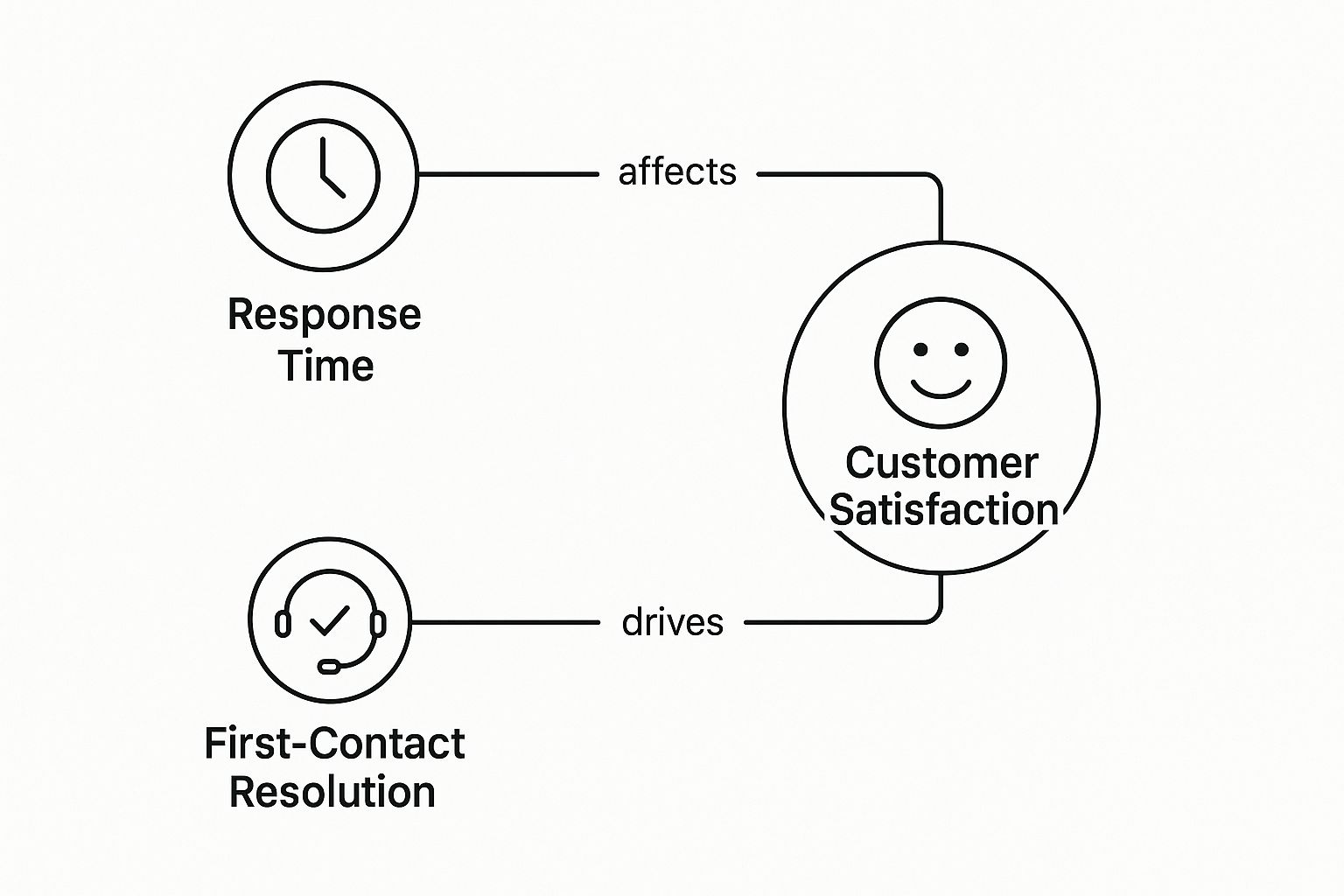
As you can see, quick response times are great, but they're meaningless if they don't lead to real satisfaction and first-contact resolution. That's a balance a purely AI-driven approach often struggles to find.
Building a Hybrid Service Model
So, what's the answer? It’s not about ditching AI. It’s about integrating it intelligently into a hybrid model where technology and people play to their strengths. This approach is fundamental for building a service operation that’s both efficient and effective. To see how this fits into a bigger picture, you can learn more about the impact of using omnichannels in contemporary call centres.
Here’s a practical look at how a hybrid framework operates:
- AI as the First Responder: Let chatbots handle the front lines. They can field initial questions, sort and route inquiries, and manage high-volume, simple tasks like booking appointments or resetting passwords.
- Seamless Human Handoff: The moment the AI detects frustration, complexity, or certain keywords that signal a sensitive problem, it must offer a smooth, one-click handoff to a human agent. No friction, no endless loops.
- Empowered Human Agents: With the repetitive stuff out of the way, your human team is free to focus on what they do best: complex problem-solving, building genuine customer relationships, and delivering the kind of empathetic support that automation simply can't touch.
A well-designed hybrid model doesn’t replace humans; it elevates them. It turns your support team from problem-solvers into relationship-builders—a critical differentiator in any market.
Of course, a key part of this is making your AI as smart as possible from the start. This involves properly training a chatbot with your own data so it deeply understands your business and can handle those initial interactions well, knowing exactly when to pass the baton. By striking this delicate balance, you can get the efficiency technology promises without losing the human connection that creates lasting loyalty.
Using Data to Craft Hyper-Personalised Experiences

In a market as sophisticated and demanding as Dubai, generic, one-size-fits-all service just doesn't cut it anymore. The city's top brands are pulling ahead by turning every customer touchpoint into a genuinely personal conversation. This isn’t about just knowing a customer's name; it's about anticipating their needs before they even have to ask.
The secret to getting this right? It all comes down to data. Every time a customer interacts with your business—whether it's a past purchase, a support ticket, a click on your website, or a comment on social media—they leave behind a clue. When you gather and analyse these clues, they reveal a clear picture of what your customer truly wants and expects. This is the bedrock of exceptional customer service in Dubai.
From Data Points to Customer Portraits
Think of your raw customer data like individual pixels in a photograph. A single pixel, like one past purchase, doesn't tell you much. But when you start piecing thousands of them together—purchase history, browsing behaviour, previous support issues, feedback scores—a detailed portrait of your customer starts to take shape. Suddenly, you're not looking at an account number; you're seeing a real person with distinct preferences, pain points, and expectations.
To really nail these hyper-personalised experiences, you need solid tools for customer experience analytics. These platforms help connect the dots, turning those scattered data points into actionable insights that empower your team to deliver truly bespoke support.
This sharp focus on data-driven personalisation has reshaped customer service in the region. Businesses in critical sectors like banking, hospitality, retail, and telecommunications are all using analytics to deliver highly customised interactions. For example, UAE neo-banks use transaction data to suggest relevant financial products, while luxury hotel groups like Jumeirah use guest histories to tailor stays down to the last detail. It's a delicate balance, of course—blending sophisticated data use with strong privacy protections is key to maintaining customer trust.
The Power of Proactive Service
Once you have this detailed customer portrait, you can make a crucial shift from being reactive to proactive. Instead of just waiting for problems to pop up, you can see them coming and step in with a solution before the customer even feels the friction.
Here are a few real-world examples of what this looks like:
- For a frequent traveller: A hotel’s system flags an upcoming stay for a guest who previously complained about slow room service. The team is alerted to personally check on their orders, and a welcome note acknowledges their loyalty. A potential complaint becomes a moment of delight.
- For an e-commerce shopper: A customer keeps browsing a specific product category but never completes a purchase. They receive a targeted email with a small, one-time discount for an item in that category, giving them the perfect nudge to buy.
- For a software user: Someone has repeatedly searched the help centre for the same feature. They're proactively sent a short video tutorial on that exact function, saving them from further frustration.
Hyper-personalisation is the art of making each customer feel like they are your only customer. It shows you listen, you remember, and you care.
Creating a Powerful Feedback Loop
Data-driven personalisation isn't a "set it and forget it" task. It's a constant cycle of learning and improving. This feedback loop is the engine that keeps a world-class service operation running, ensuring you're always adapting to what your customers need.
The loop itself is straightforward and involves four key stages:
- Collect Data: Gather information from every touchpoint—your CRM, support tickets, satisfaction surveys, social media, and more.
- Personalise Service: Use what you've learned to tailor interactions and offer proactive help.
- Measure Satisfaction: After a personalised interaction, ask for feedback. CSAT and NPS surveys are perfect for this.
- Refine and Repeat: Analyse the feedback to see what worked and what didn't. Use those lessons to make the next interaction even better.
When you master this cycle, you're doing more than just solving problems. You're creating memorable experiences that make customers feel seen and valued, turning them into loyal advocates who give you an undeniable edge in Dubai's competitive market.
Navigating Dubai's Consumer Protection Laws

In Dubai, exceptional customer service isn't just a good idea for getting ahead of the competition—it's the law. The local regulations are built to protect consumers and maintain the city's global reputation for excellence. For any business operating here, that means compliance isn't optional; it's a fundamental part of your operations.
Think of these consumer protection laws as the non-negotiable rulebook for earning and keeping customer trust. It’s no different from a high-end restaurant needing to pass rigorous health inspections. Your business must know and follow these rules to thrive and avoid some serious penalties. Getting this right is the first step to providing truly great customer service in Dubai.
The Role of Dubai's DET
The main authority keeping everyone in line is the Department of Economy and Tourism (DET), specifically its Commercial Compliance & Consumer Protection (CCCP) sector. The DET plays a dual role: it's a guide for businesses aiming to do the right thing and a watchdog ensuring the marketplace stays fair for consumers.
Essentially, the DET's job is to protect consumer rights, look into complaints, and penalise businesses that don't play by the rules. If you ignore their guidelines, you’re looking at official warnings, steep fines, and public call-outs that can really damage your brand's reputation.
Core Principles of Consumer Protection
While the complete Federal Law on Consumer Protection is quite detailed, it all boils down to a few core principles that should shape your everyday customer interactions. Following them isn't just about staying out of trouble; it's about showing your customers you run an ethical, trustworthy business.
Here are the key requirements you must have locked down:
- Transparency and Honesty: Your marketing, pricing, and product details must be completely clear and accurate. No hidden fees or misleading claims. All terms and conditions need to be stated upfront.
- Product Quality and Safety: You are accountable for the quality and safety of what you sell. The goods or services must be fit for the purpose you advertised them for.
- Fair Return and Exchange Policies: You must have a clear, easy-to-find policy for returns and exchanges, especially for faulty items. A customer has a legal right to a replacement, repair, or refund when a product is defective.
- Honouring Warranties: If you offer a warranty or guarantee with a purchase, you absolutely must honour it. This is a critical—and non-negotiable—part of the post-sale experience.
Complying with consumer protection laws is the ultimate foundation of customer trust. It shifts service from a "nice-to-have" courtesy to a concrete, legally backed promise of quality and fairness.
Translating Law into Action
Meeting these standards means they need to become second nature to your team. It’s about training your customer service staff to not just know these consumer rights but to actively champion them in every single conversation.
For instance, when a customer calls about a faulty product, your agent's script shouldn't just be about being polite; it should be guided by the law. They need to know the exact process for a warranty claim or a return, ensuring the customer gets a resolution that is both smooth and legally compliant.
When you turn these legal duties into everyday actions, you do more than just protect your business. You build unshakable customer loyalty and become part of the very fabric of excellence that defines the Dubai market.
Your Blueprint for World-Class Service Delivery
Turning great customer service from a talking point into reality is all about deliberate, practical action. It's time to build a system where every single element, from your team to your tech, is laser-focused on one thing: exceeding the incredibly high expectations of the Dubai market. This is your blueprint to get it done.
The foundation starts with hiring, but not just for friendly faces. You need to recruit for a very specific trait: cultural intelligence. This is the innate ability to grasp and adapt to different cultural norms without missing a beat. In a melting pot like Dubai, this skill is far more valuable than a decade of generic call centre experience.
Once you have the right people, you need world-class training that goes well beyond just knowing the product. Your training should throw real-world scenarios at your team, testing their empathy, their grace under pressure, and their knack for finding personalised solutions. This is what truly prepares them for the nuanced, complex reality of providing stellar customer service in Dubai.
Engineering a Seamless Technology Stack
Even the best people can be held back by clumsy tools. A fragmented tech stack is a recipe for frustration, creating friction for your agents and, ultimately, for your customers. The aim should be a seamless omnichannel environment where information glides effortlessly between every channel you use.
Think about it: an integrated system means a customer's WhatsApp chat history appears instantly on the screen of the agent who takes their phone call. This simple connection eliminates the dreaded, "I already explained this to someone else," and arms your team with the full story. The result? Faster, smarter, and more personal service, every single time.
A truly customer-centric culture is not a departmental goal; it's an organisational state of mind. It must be championed from the C-suite and felt by every frontline employee.
This philosophy has to be more than just a poster on the wall. It requires leaders who consistently put customer feedback at the heart of strategic decisions. It also means empowering your agents with the autonomy to make things right for a customer without wading through layers of approval. When your team feels trusted, they deliver service with genuine confidence and care.
Auditing and Refining Your Operations
You can’t improve what you don’t measure. The engine of service excellence is continuous improvement, and that journey begins with an honest look at your current operations. Map out the entire customer journey, pinpoint every touchpoint, and measure performance with ruthless objectivity. It’s crucial to track the right metrics, and you can dive deeper into the most effective key performance indicators for customer service to guide your efforts.
With a clear audit in hand, you can build a solid implementation plan. The following checklist breaks down the essential components you'll need to elevate your service to meet Dubai's demanding standards.
Service Excellence Implementation Checklist
This checklist outlines the core components for building a superior customer service operation in Dubai, moving from strategy to tangible actions.
| Component | Key Action | Success Metric |
|---|---|---|
| Talent Acquisition | Recruit for cultural intelligence and empathetic problem-solving skills, not just experience. | Reduced agent turnover and improved Customer Satisfaction (CSAT) scores. |
| Omnichannel Tech | Implement a unified platform for all channels (voice, chat, social) with CRM integration. | Increased First Contact Resolution (FCR) rate and lower average handling time. |
| Customer-Centric Culture | Empower agents with autonomy and ensure leadership visibly prioritises customer feedback. | Higher Net Promoter Score (NPS) and positive employee engagement survey results. |
| Performance Audit | Regularly map customer journeys and analyse performance data to identify friction points. | Consistent improvement in key metrics and reduction in customer complaints. |
This blueprint gives you a structured path forward. By focusing on hiring the right people, giving them the best tools, fostering a supportive culture, and committing to relentless refinement, your business can build a service operation that doesn't just survive but genuinely thrives in the competitive Dubai market.
Frequently Asked Questions About Customer Service in Dubai
Setting up shop in Dubai is one thing, but truly connecting with its unique customer base is another. Businesses often have a lot of practical questions about what it takes to get customer service right in this market. Answering them correctly is crucial for building a strategy that meets—and exceeds—the region's notoriously high expectations.
Let's break down some of the most common questions we hear.
What’s the Biggest Mistake Foreign Companies Make?
Easily the most common pitfall is underestimating the need for genuine cultural adaptation. Too many international companies try to transplant a generic Western or Asian service model directly into the Dubai market, and it almost always falls flat. They don't adjust for local communication styles, etiquette, or cultural norms, which can create a lot of unintentional friction.
This one-size-fits-all approach completely overlooks the nuanced expectations of a population that includes both Emiratis and a vast array of expatriates. To succeed, you need a deep appreciation for these differences. It’s about moving past a cookie-cutter strategy and creating a more localised, respectful way of engaging with people.
Is WhatsApp a Mandatory Customer Service Channel?
While there's no law saying you have to use it, operating without WhatsApp support in Dubai is a major business handicap. Customer preference for the app is incredibly high; its immediacy and convenience have made it the go-to communication tool for millions across the region.
If your business isn't on WhatsApp, you risk looking outdated and hard to reach. You’re essentially telling customers you won’t meet them where they are most comfortable, which can lead to frustration and lost opportunities as they turn to more accessible competitors.
Integrating WhatsApp isn't just about adding another icon to your website. It's a fundamental signal that you understand and respect how your customers live and communicate. In the UAE, it's a core part of being truly customer-centric.
How Important Is Arabic Language Support?
It's absolutely critical. While English is the common language of business and is widely spoken, offering high-quality support in Arabic is a profound sign of respect and commitment to the region.
For serving the Emirati population and other Arabic-speaking customers, it's non-negotiable. Beyond that, it aligns with government initiatives to preserve and promote the Arabic language. Even for non-Arabic speakers, seeing that you offer it sends a powerful message: your business is invested in the local culture. This builds incredible brand trust and goodwill. Simply put, it's a key differentiator that top-tier companies always prioritise.
Ready to elevate your service delivery and meet the high standards of the Dubai market? Cloud Move provides specialised cloud contact centre solutions that integrate seamlessly with your CRM and unify all your communication channels, including WhatsApp, social media, and voice. Discover how our flexible deployments can transform your customer engagement today.